
Large parts of Europe are currently experiencing one of the most intense heatwaves in recent years. Temperatures have exceeded 40°C in several countries, prompting red weather warnings, increasing pressure on healthcare systems, disrupting transport networks, and raising wildfire risks. Hungary, Romania, Slovakia, Croatia and several other countries have activated emergency measures, while more than 100 million Europeans have been exposed to dangerous heat conditions.
Meteorologists attribute this event to a heat dome, a persistent high-pressure system that traps hot air over a region for several days or even weeks. Although heat domes are natural atmospheric phenomena, scientists agree that a warmer climate increases the likelihood that these events become more frequent, longer-lasting and more intense. The Guardian
As Europe continues to warm faster than the global average, extreme heat is becoming not only an environmental concern but also an economic, social and public health challenge. This makes the current heatwave particularly relevant in the context of the European Union’s Fit for 55 strategy, which aims to reduce greenhouse gas emissions while strengthening climate resilience. Reuters
What is a heat dome?
A heat dome occurs when a strong and persistent high-pressure system settles over a region, effectively acting like the lid of a pot.
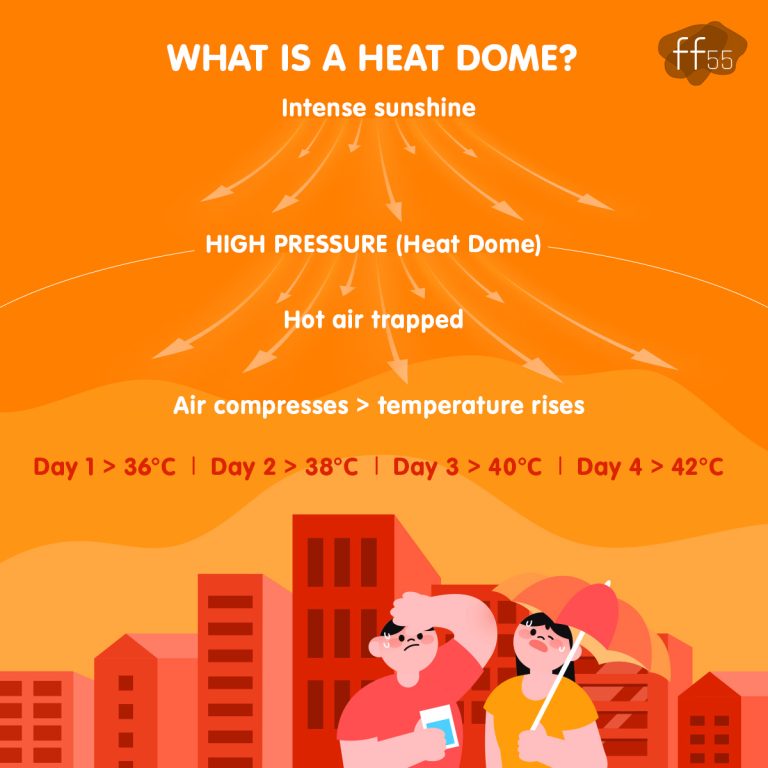
As air sinks beneath the high-pressure system, it becomes compressed and warmer. At the same time, cloud formation is suppressed, allowing intense solar radiation to heat the ground throughout the day. Because the system remains relatively stationary, heat accumulates day after day, while nighttime temperatures often remain unusually high. Fox Weather
The European Space Agency (ESA) explains that the current heatwave has developed because a persistent high-pressure system became trapped between surrounding low-pressure systems, preventing cooler air from entering the region.
Is climate change responsible?
The relationship between heatwaves and climate change is often misunderstood.
A single heatwave cannot be attributed solely to climate change, as individual weather events are driven by atmospheric circulation patterns. However, climate change increases the baseline temperature from which these weather systems develop.
In practical terms, this means that when a heat dome forms today, it is more likely to produce record-breaking temperatures than it would have several decades ago. Natural Environment Council
Recent analyses by the World Weather Attribution initiative concluded that the current European heatwave would have been extremely unlikely without human-induced global warming and that similar events have become substantially more probable as global temperatures continue to rise.
Why this matters for Fit for 55
Although the Fit for 55 package is primarily known as the EU’s emissions reduction strategy, its objectives extend beyond reducing carbon emissions.
By accelerating renewable energy deployment, improving energy efficiency and modernising buildings and infrastructure, Fit for 55 also helps Europe become more resilient to extreme weather.
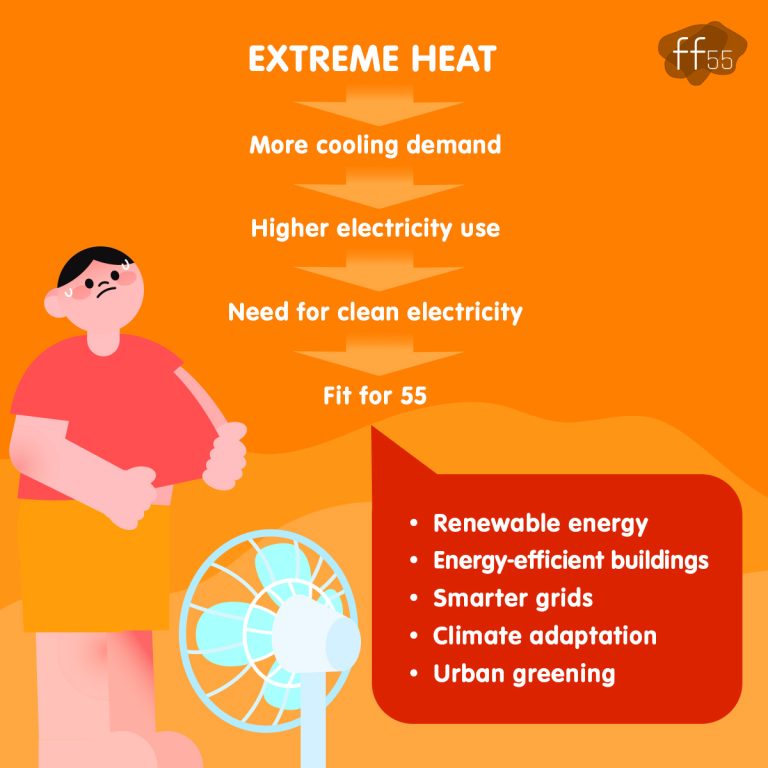
Several initiatives within the package are directly relevant during heatwaves:
- improving building insulation reduces indoor overheating;
- increasing renewable electricity supports growing cooling demand;
- modern electricity grids improve system reliability during peak consumption;
- energy-efficient buildings reduce both emissions and summer cooling costs;
- urban greening and sustainable planning help reduce heat accumulation.
While adaptation measures address today’s risks, emission reductions remain essential for limiting the severity of future heatwaves. Battery Innovation European Council
What can governments and cities do?
Extreme heat requires both emergency response and long-term planning.
Immediate actions
Authorities can reduce health risks by:
- issuing early heat warnings;
- opening public cooling centres;
- providing access to drinking water;
- protecting vulnerable populations such as elderly people and young children;
- adjusting outdoor working hours during peak heat.
Many European countries have already implemented these measures during the current heatwave.
Long-term adaptation
Cities can become significantly more resilient through:
- planting more urban trees;
- expanding parks and green corridors;
- installing green roofs and green walls;
- using reflective building materials;
- improving passive building cooling;
- redesigning public spaces to provide shade.
These measures not only reduce temperatures but also improve air quality and overall quality of life. TIME Hungary Today
Conclusion
The current European heatwave is more than a temporary weather event. It highlights how climate change is interacting with natural atmospheric patterns to produce increasingly severe and prolonged periods of extreme heat.
While no single weather event can be explained by climate change alone, scientific evidence clearly shows that rising global temperatures are making heatwaves more frequent, more intense and more dangerous.
The Fit for 55 package addresses one side of this challenge by reducing greenhouse gas emissions. However, Europe must also continue investing in climate adaptation, from smarter buildings and greener cities to more resilient infrastructure and better public health preparedness.
The question is no longer whether Europe will experience future heatwaves. The more important question is whether our cities, businesses and communities will be prepared when they arrive.