Food prices are influenced by many factors, including energy and fertiliser costs, labour, transport, exchange rates and global commodity markets. Increasingly, weather extremes are another variable affecting agricultural production and, indirectly, the prices consumers encounter in supermarkets.
Climate change does not determine the price of an individual product. However, scientific research indicates that rising temperatures and changes in drought, rainfall and heat extremes can affect crop yields and increase volatility across food supply chains.
From heatwave to harvest
Agriculture is particularly sensitive to temperature and water availability. Excessive heat can shorten grain-filling periods, reduce pollination and increase water stress, while drought limits soil moisture and irrigation supplies.
This relationship is visible in current European data. In July 2026, the European Commission’s Joint Research Centre (JRC) reduced EU yield forecasts for winter crops by 1-4% following repeated heatwaves. Forecasts for grain maize and sunflower were cut by around 6-7%.
Conditions deteriorated further during August. The JRC reported that exceptional heat and water deficits had pushed forecasts for EU summer crops to as much as 14% below the five-year average, with some regions facing severe losses or potential crop failure.
The effects are not uniform. Northern and eastern regions experienced more favourable conditions, demonstrating why a heatwave in one part of Europe does not automatically translate into an EU-wide food shortage.
What does this mean for prices?
Lower harvests can reduce supply and increase agricultural commodity prices, but the transmission to supermarket prices is complex. Processing, packaging, transport, energy costs, imports and retailer margins all influence the final price.Nevertheless, researchers have identified a measurable relationship between extreme heat and food inflation.
European Central Bank (ECB) research estimates that Europe’s extreme summer heat in 2022 increased food inflation by approximately 0.67 percentage points over the following 12 months. Under projected warming, a comparable extreme summer could have an impact of around 1 percentage point by 2035 and potentially close to 1.8 percentage points by 2060, although these estimates depend on future emissions and economic conditions.
The ECB also notes that recent weather extremes have contributed to substantial commodity-price increases for products including olive oil, cocoa and coffee.
Agriculture’s growing exposure
The European Environment Agency (EEA) estimates that drought accounts for approximately 54% of climate-related agricultural losses in the EU, followed by heavy rainfall (21%), frost (16%) and hail (9%). In particularly dry years, crop yields can fall by as much as 22%.
In 2025 alone, drought affected an estimated 927,648 km² of Europe, while approximately 111,739 km² of cropland failed to recover to normal vegetation productivity levels. European Parliament
Long-term projections also vary considerably by region and crop. EEA assessments indicate that, without sufficient adaptation, climate-related changes could reduce maize and wheat yields in parts of southern Europe by up to 49% by 2050.
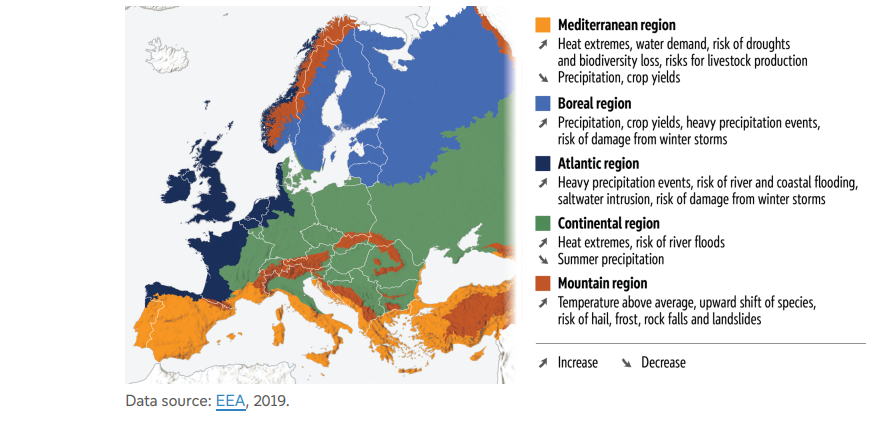
From climate risk to economic risk
Food inflation therefore represents one pathway through which physical climate risks can reach households. The chain is rarely direct:
extreme weather → crop damage → lower or more volatile supply → commodity-price changes → processing and distribution → retail prices.
International trade, inventories and substitution between products can absorb part of the shock, while simultaneous crop failures across major producing regions can amplify it. ResearchGate
Conclusion
Extreme weather is only one of many forces determining food prices, and individual price increases cannot automatically be attributed to climate change. However, European agricultural and inflation data show that temperature and precipitation extremes can influence harvests and subsequently contribute to food-price volatility.
For Europe, the economic issue therefore extends beyond agricultural production itself. Climate resilience in farming, water management, trade and food supply chains is increasingly relevant to the stability of prices consumers ultimately see on supermarket shelves.