
Europe imports substantial quantities of raw materials while simultaneously generating waste that contains potentially recoverable resources. Could a more circular economy reduce this dependence and create new industrial opportunities?
The European Commission’s planned Circular Economy Act, scheduled for 2026, aims to improve the market for secondary raw materials and strengthen demand for recycled resources.
The initiative comes at a time when Europe’s transition towards circular material use remains relatively slow.
How circular is Europe’s economy?
According to Eurostat, 12.2% of materials used in the EU in 2024 came from recycled sources.
Although this was the highest rate recorded, it represented an increase of only 0.1 percentage points compared with 2023 and 1.0 percentage point compared with 2015.
The EU’s Circular Economy Action Plan established an ambition to reach a circular material use rate of approximately 23.2% by 2030.
Progress therefore remains well below the level implied by that ambition.
Importantly, the circular material use rate measures recycled materials’ contribution to total material consumption. It is not equivalent to the share of municipal waste recycled.
Significant Differences Between Countries
Circularity varies considerably across Member States.
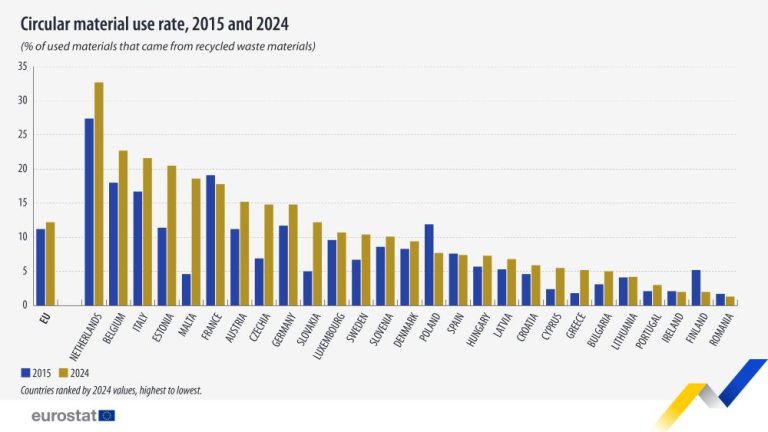
In 2024, the highest rates were recorded in:
- Netherlands: 32.7%
- Belgium: 22.7%
- Italy: 21.6%
At the other end of the scale:
- Romania: 1.3%
- Finland: 2.0%
- Ireland: 2.0%
These differences reflect variations in economic structure, domestic resource extraction, material demand and recycling systems. Eurostat
Between 2015 and 2024, circularity increased in 21 EU countries, while six recorded declines.
The largest increases included Malta, at 14.0 percentage points, and Estonia, at 9.1 percentage points.
Which materials are most circular?
The potential for recycling differs between material categories.
Eurostat reported the following EU circular material use rates for 2024:
Material category | Circularity rate |
Metal ores | 23.4% |
Non-metallic minerals | 14.3% |
Biomass | 9.9% |
Fossil energy materials | 3.8% |
Metals often have established recovery markets, but recycling efficiency still depends on collection, sorting, contamination and processing technology. For other materials, technical limitations or low economic value can make recovery more difficult. Eurostat
What could the circular economy act change?
The European Commission intends the planned legislation to support a functioning EU-wide market for secondary raw materials. Its stated objectives include improving the availability of high-quality recycled materials and stimulating demand from European industry. Potential benefits include more predictable supply chains, greater resource efficiency and new investment opportunities in recycling and material recovery.
However, the precise legal obligations will depend on the legislation ultimately adopted. A planned policy initiative should not be confused with rules already in force.
Existing legislation, including the Ecodesign for Sustainable Products Regulation, Batteries Regulation and Critical Raw Materials Act, already addresses parts of the circular economy. Ellen Macarthur Foundation
Can recycling improve competitiveness?
Secondary raw materials can reduce the need for some primary extraction and imports. Depending on the material and production process, they may also require less energy. But recycled inputs are not automatically cheaper.
Collection and processing facilities require investment. Manufacturers need consistent material quality, reliable volumes and competitive prices. In some markets, virgin materials may remain less expensive, particularly when environmental costs are not fully reflected in prices.
Circularity also extends beyond recycling. Repair, refurbishment, reuse and longer product lifetimes can preserve economic value before materials become waste. ResearchGate
Conclusion
Europe’s circular economy presents both an environmental objective and an industrial policy challenge.
The EU’s current 12.2% circularity rate demonstrates that recycled materials remain a relatively small share of overall material use.
Whether the Circular Economy Act improves competitiveness will depend on its final provisions, implementation costs, investment conditions and the ability of European businesses to develop reliable markets for secondary resources.
Key Takeaways
- Only 12.2% of EU material use came from recycled sources in 2024.
- The Netherlands led the EU with a circularity rate of 32.7%.
- The EU aims to approximately double circular material use by 2030.
- The Circular Economy Act is intended to strengthen secondary raw-material markets.
- Economic viability, material quality and demand will determine its practical impact.