As Europe enters another heating season, millions of households switch on their boilers, stoves and heating systems. While attention often focuses on energy prices, winter heating also raises an important public-health question: what happens to the air we breathe?
According to the European Environment Agency (EEA), an estimated 182,000 deaths in the EU in 2023 were attributable to long-term exposure to fine particulate matter (PM₂.₅) above World Health Organization guidelines. This figure reflects air pollution from multiple sources throughout the year, not residential heating alone.
Nevertheless, household heating is an important contributor to winter pollution, particularly where solid fuels are widely used.
Why can winter air quality deteriorate?
Residential heating systems produce different emissions depending on their fuel and technology.
Burning wood and coal can release fine particulate matter, carbon monoxide, nitrogen oxides and other pollutants. PM₂.₅ particles measure 2.5 micrometres or less in diameter and can penetrate deep into the lungs.
Weather conditions also matter. During a temperature inversion, warmer air above the ground restricts the vertical movement of colder air, allowing pollutants to accumulate near the surface.
Consequently, even unchanged emissions can produce higher local concentrations under unfavourable meteorological conditions.
Traffic, industrial activity, agriculture and pollution transported across borders can further contribute to winter smog. EEA UNECE WHO
What do the health statistics show?
The EEA‘s 2025 assessment estimated that meeting WHO air-quality guidelines could have prevented, in the EU during 2023:
- 182,000 deaths attributable to PM₂.₅ exposure.
- 63,000 deaths attributable to ozone exposure.
- 34,000 deaths attributable to nitrogen dioxide exposure.
These estimates must not be added together, because the health effects and exposure patterns overlap.
The assessment also found that approximately 95% of Europe’s urban population was exposed to air pollution above WHO recommendations.
Long-term exposure is associated with cardiovascular and respiratory diseases, including ischaemic heart disease, chronic obstructive pulmonary disease and lung cancer.
tellus, luctus nec ullamcorper mattis, pulvinar dapibus leo.
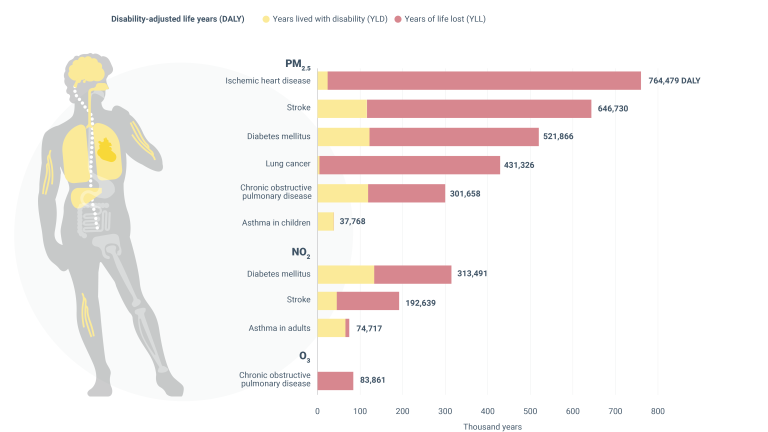
Source: EEA
Is Europe making progress?
There are measurable improvements. Between 2005 and 2023, EU emissions of fine particulate matter declined by approximately 38%. Over the same period, estimated premature deaths attributable to PM₂.₅ exposure above WHO guidelines fell by 57%.
These improvements reflect changes in electricity generation, residential fuel use, transport technologies and environmental regulation.
However, declining emissions do not eliminate exposure risks. Pollution remains unevenly distributed, and local conditions can differ considerably between countries, cities and neighbourhoods. EEA
What role does heating technology play?
Heating choices involve several environmental considerations.
Modern heat pumps produce no combustion-related emissions at the building itself. District heating can also reduce local pollution, although its overall environmental performance depends on the energy sources supplying the network.
Wood heating presents a different trade-off. Biomass may qualify as renewable energy under certain accounting rules, but burning wood still produces air pollutants. Renewable-energy classification and local air quality are therefore separate questions. Heat Pumps Watch
Improved insulation can reduce heating demand regardless of the energy source. However, replacing equipment requires investment. For lower-income households, the availability of financial assistance can strongly influence which improvements are realistic. ResearcGate
What is changing under EU law?
The revised Ambient Air Quality Directive, adopted in 2024, introduces stricter standards for 2030. The annual EU limit for PM₂.₅ will fall to 10 µg/m³, compared with the WHO guideline of 5 µg/m³. European Commission
The EU’s Zero Pollution Action Plan also seeks to reduce premature deaths associated with air pollution by at least 55% by 2030, compared with 2005. According to the EEA’s latest assessment, this reduction had already been achieved for PM₂.₅-related mortality in 2023.
Maintaining that progress will require continued attention to pollution sources and population exposure.
From targets to action: how will Europe reduce pollution?
Stricter air-quality limits are only part of the response. Achieving cleaner air will also depend on how Member States modernise heating systems, improve building insulation, support cleaner technologies and help households finance these changes. EU instruments such as the Energy Performance of Buildings Directive, the Social Climate Fund and national renovation programmes can contribute to this transition, although their implementation and funding conditions differ between countries.
But how will these policies work in practice, who will receive financial support, and will they be sufficient to reduce pollution without increasing energy costs for vulnerable households? These questions will be explored in the next article in this series.
Conclusion
Europe has substantially reduced air pollution over the past two decades, but the remaining health burden is considerable.
Winter air quality depends on the interaction of heating systems, building efficiency, transport, industry and weather conditions. No single technology or policy measure can address every source.
Reducing emissions while maintaining affordable and reliable heating remains an important challenge for European households and policymakers.
Key Takeaways
- 182,000 estimated deaths in the EU in 2023 were attributable to PM₂.₅ exposure above WHO guidelines.
- EU PM₂.₅ emissions declined by 38% between 2005 and 2023.
- Cold-weather inversions can increase local pollution concentrations.
- The EU’s annual PM₂.₅ limit will tighten to 10 µg/m³ in 2030.
- Cleaner heating, building efficiency and targeted support can contribute to better air quality.