

What if a building could predict when rooms will be occupied, adjust heating before the weather changes and detect an inefficient ventilation system before anyone notices a problem?
This is increasingly the idea behind the AI-powered smart building. With buildings accounting for around 40% of EU energy consumption, even relatively small efficiency improvements can matter at scale. Artificial intelligence is adding a new layer to traditional building automation: instead of simply following fixed schedules, systems can learn from occupancy, weather, energy prices and historical consumption. ScienceDirect
From thermostats to predictive buildings
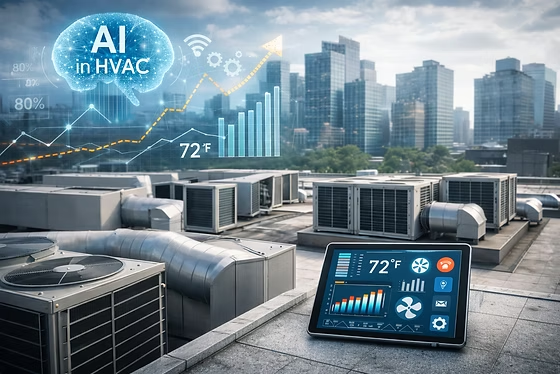
Heating, ventilation and air conditioning (HVAC) are particularly suitable for intelligent control. AI systems can combine data from temperature, CO₂ and occupancy sensors with weather forecasts and previous energy use to predict how much heating or cooling a building actually needs. The potential savings can be substantial, although results vary widely.
A 2025 systematic review and meta-analysis covering 126 peer-reviewed studies, 45 countries and more than 2.8 million building-hours found average energy savings of 22.3% for reinforcement-learning approaches, 14.7% for supervised learning and 28.1% for hybrid AI methods. For HVAC specifically, the average reported reduction was 19.7%. SpringerNature
Lorem ipsum dolor sit amet, consectetur adipiscing elit. Ut elit tellus, luctus nec ullamcorper mattis,
A 2025 systematic review and meta-analysis covering 126 peer-reviewed studies, 45 countries and more than 2.8 million building-hours found average energy savings of 22.3% for reinforcement-learning approaches, 14.7% for supervised learning and 28.1% for hybrid AI methods. For HVAC specifically, the average reported reduction was 19.7%. SpringerNature
A separate 2026 review of 50 studies found that AI-based optimisation commonly produced savings of roughly 15-30% compared with static set-point controls, although some simulation-based scenarios exceeded 40%. These numbers should be treated cautiously. Building type, climate, existing equipment and the baseline used for comparison can dramatically affect the result. SpringerNature
dapibus leo.
AI does more than control temperature
Smart systems can also dim lighting when daylight is sufficient, identify unusually high consumption, schedule equipment when electricity demand is lower and predict maintenance problems before equipment fails.
The EU is already incorporating this concept into building policy through the Smart Readiness Indicator (SRI). It assesses smart-building capabilities across nine technical domains, including heating, cooling, ventilation, lighting, electricity, EV charging, hot water, dynamic building envelopes, and monitoring and control. The goal is not simply automation. Smart buildings should be able to optimise energy performance, respond to occupants and interact more flexibly with the electricity grid. European Commission
Not every building will save 30%
AI is not an automatic efficiency guarantee. Poor sensors, insufficient data, outdated equipment, cybersecurity risks and badly configured algorithms can limit the benefits. Research also remains uneven. One large meta-analysis found that 78% of the reviewed studies focused on offices, while only a minority of reported deployments represented real-world operational use. ScienceDirect
That distinction matters. A 25% saving demonstrated in a simulation does not mean every apartment block or office will achieve the same result. The strongest case for AI is therefore not that it makes buildings “intelligent” overnight. It is that it can help buildings use energy when and where it is actually needed, turning millions of individual heating, cooling and lighting decisions into measurable efficiency gains.ResearchGate
Key Takeaways
– AI can significantly reduce building energy consumption. Research indicates average HVAC energy savings of around 19.7%, with some AI optimisation methods achieving even greater reductions.
– Predictive control makes buildings more efficient. AI can use occupancy data, weather forecasts and historical consumption to adjust heating, cooling and ventilation according to actual demand.
– Smart buildings go beyond temperature control. AI can optimise lighting, detect energy waste, support predictive maintenance and help buildings respond to electricity grid conditions.
– Energy savings depend on building characteristics and implementation. Existing infrastructure, sensor quality, climate and system configuration all influence results, while simulation-based savings may not translate directly into real-world performance.
– AI is becoming an important tool for building decarbonisation. By reducing unnecessary energy use and improving operational flexibility, intelligent building systems can support Europe’s energy efficiency and climate goals.