
Four closed quarries. Tens of millions of tonnes of extracted rock. Asbestos found in roads, car parks and public spaces in both Austria and Hungary. How did a carcinogenic substance whose dangers have been known for decades end up in everyday infrastructure?
In January 2026, Austrian authorities ordered the immediate closure of four quarries in Burgenland: Rumpersdorf, Badersdorf, Bernstein and Pilgersdorf. Official material and soil samples taken in November 2025 all tested positive for asbestos. More than eight months later, in September 2026, the quarries were still closed. Euronews
But the story does not end at the quarry gates.
A material with no safe form
Asbestos is the collective name for a group of naturally occurring fibrous minerals. The World Health Organization classifies all forms of asbestos as carcinogenic. Exposure can cause mesothelioma, lung, laryngeal and ovarian cancer, as well as asbestosis.
According to WHO estimates, occupational exposure to asbestos causes more than 200,000 deaths worldwide every year and accounts for more than 70% of deaths from work-related cancers.
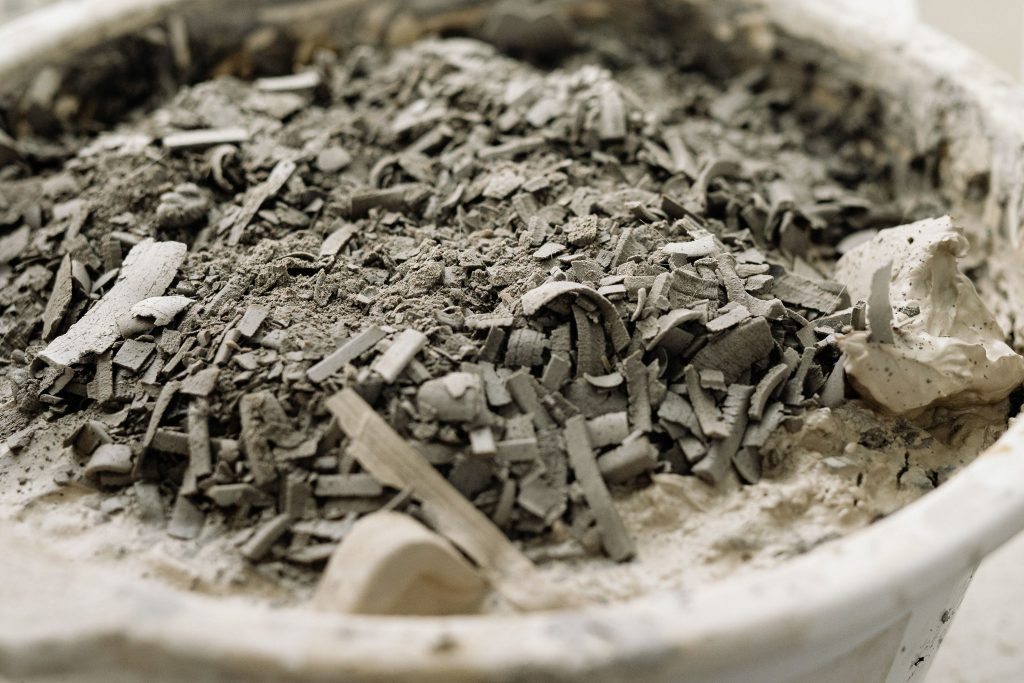
What makes the Austrian case unusual is that it does not concern old asbestos-cement buildings. The quarries in Burgenland extracted serpentinite, a rock that can naturally contain asbestos minerals. The stone was crushed, graded and used for purposes including road base material and frost-protection layers. Atlatszo
Tens of millions of tonnes, but exactly how much?
According to Greenpeace, between 1.2 and 1.4 million tonnes of serpentinite have been extracted annually in the affected region since 2020, based on figures published in Austria’s official mining statistics. Extrapolating from available production data, Greenpeace estimates that nearly 50 million tonnes of potentially asbestos-containing rock may have been extracted since 1990. This figure is an estimate rather than a documented total of confirmed asbestos-containing material. Ungiftig / Greenpeace
For its separate remediation cost model, Greenpeace used a more conservative assumption of 26 million tonnes of asbestos-containing rock, of which it estimates around 20 million tonnes could eventually require disposal. Hungary TodayIn a separate cost model, Greenpeace used a more conservative estimate of 26 million tonnes of asbestos-containing material. It estimates that around 20 million tonnes of this material could eventually require disposal in dedicated asbestos waste facilities. The organisation puts the minimum cost of identification, removal and disposal at €1.6 billion. Portfolio / Ungiftig
These figures are Greenpeace estimates, not official government damage assessments.
It is not only underground
Greenpeace investigations found asbestos concentrations of 20–50% in samples from several locations, while some samples exceeded 50%. The organisation identified affected material near a hospital, at a skatepark, in car parks and on public roads. But the list of affected sites has continued to grow including places used by children.
In Hungary, official investigations identified asbestos-containing crushed stone at or near kindergartens, schools, a nursery, a playground and student accommodation. In Szombathely, affected material was identified in the car park of the Középhegyi Waldorf Kindergarten, while investigations in Kőszeg identified contaminated material at locations including the car park of the Meseváros Kindergarten and Nursery, school car parks and a pedestrian path at a municipal playground. Hungary Today
The findings illustrate how widely construction aggregate can spread once it enters ordinary supply chains: from roads and residential driveways to public facilities and places used by children.
The issue is still developing. On 23 September 2026, Greenpeace Austria reported that it had received notifications concerning 22 sites around schools and kindergartens in eastern Austria where asbestos-containing material was suspected in gravel, asphalt, stone walls and other surfaces. Most remain suspected cases requiring verification; Greenpeace said samples from two locations had tested positive.
Explore Greenpeace’s interactive map of documented findings, reported locations and remediated sites across Austria and Hungary:
https://maps.greenpeace.org/maps/gpcee/austria-asbestos/?lang=hu
In July 2026, the investigation also reached Vienna. Greenpeace flagged suspected asbestos-containing asphalt on eight roads in Vienna and the surrounding area. Laboratory tests on samples from two roads identified almost pure amphibole asbestos.
The question is therefore no longer simply whether asbestos was present in the rock. It is where the material extracted over decades ended up and under what conditions it can release respirable fibres into the air.
Regulation existed. So how did this happen?
This is where the case becomes particularly complex. In 2026, a dispute emerged in Austria over which rules applied to naturally occurring asbestos in quarried rock. Quarry operators themselves argued that Austria had no specific threshold value for asbestos content in rock and challenged some of the measurement methods used by Greenpeace and the authorities. EUalive
By September, Austria’s Environment Ministry had issued further legal clarification: rock that had merely been crushed and sorted by size should be classified as a “material” rather than a “product.”
That distinction matters. It shows that even in the case of a known hazardous substance, the regulatory outcome can depend on how naturally occurring rock is legally classified, how asbestos content is measured, and which authority applies which set of rules. Ungiftig
The problem crossed the border
Rock from Burgenland also reached Hungary. In April 2026, measurements taken on a gravel road in a residential area of Szombathely recorded airborne concentrations of up to 292,000 asbestos fibres per cubic metre. According to Greenpeace, the material originated in Burgenland, and Hungarian authorities introduced protective measures. Hungary Today / Greenpeace
That changes the scale of the issue. If quarried construction material enters roads, car parks, railway infrastructure and private properties, and then moves across national borders, the problem is no longer limited to a single quarry or Austrian province.
Who maps where the material ended up? Who pays for testing? Who pays for removal and disposal as hazardous waste? And what happens at sites where the material has already been part of infrastructure for decades?
One of the core principles of EU environmental policy is the Polluter Pays Principle. In a cross-border contamination case that developed over decades, however, applying that principle raises difficult questions: Can legal responsibility be established? Can a causal link be demonstrated? And who ultimately bears the potentially billion-euro cost of remediation? The quarries have been closed. The rock they extracted did not disappear with them. European Court of Auditors / Eur-Lex
Next: who pays once the pollution has already happened?
Identifying where contaminated material ended up is only one part of the story. The next question is responsibility: who pays for testing, removal, hazardous waste management and environmental remediation?
One of the fundamental principles of European environmental law is that the costs of pollution should, in principle, be borne by those responsible for causing it. But the Polluter Pays Principle is not merely a theoretical legal concept. Over recent decades, questions of corporate liability and remediation costs have arisen and in a number of cases resulted in polluters bearing substantial costs following oil spills, industrial accidents, chemical contamination and mining disasters. ResearchGate
In the next part of this series, we will examine European and international precedents in which companies or operators responsible for pollution were required to pay compensation, contribute to clean-up costs or restore environmental damage.
From major oil spills to cyanide contamination and mining disasters, we will look at how the Polluter Pays Principle has worked in practice: who was held responsible, what they were required to pay for, and where the costs ultimately fell.
And then we return to Burgenland: what could these precedents mean for the Austrian asbestos case and who could ultimately face the bill if millions of tonnes of contaminated material have to be traced, removed and safely disposed of?